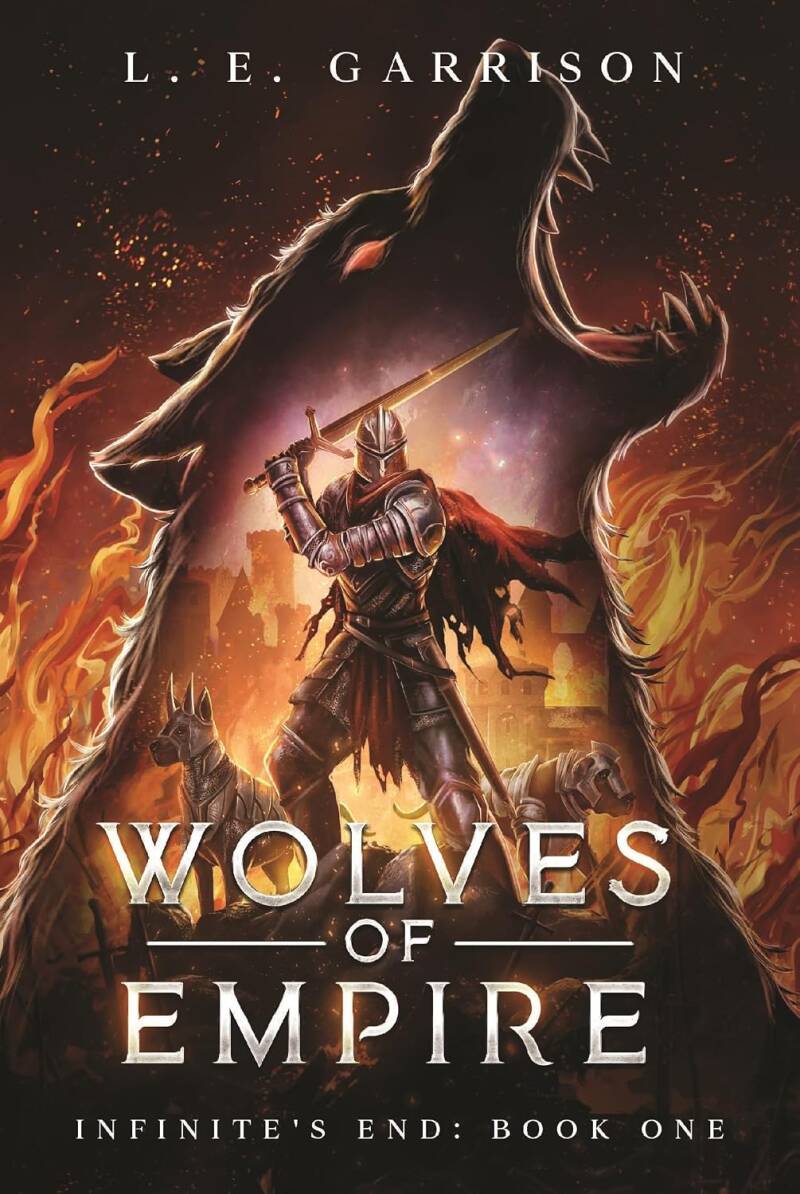
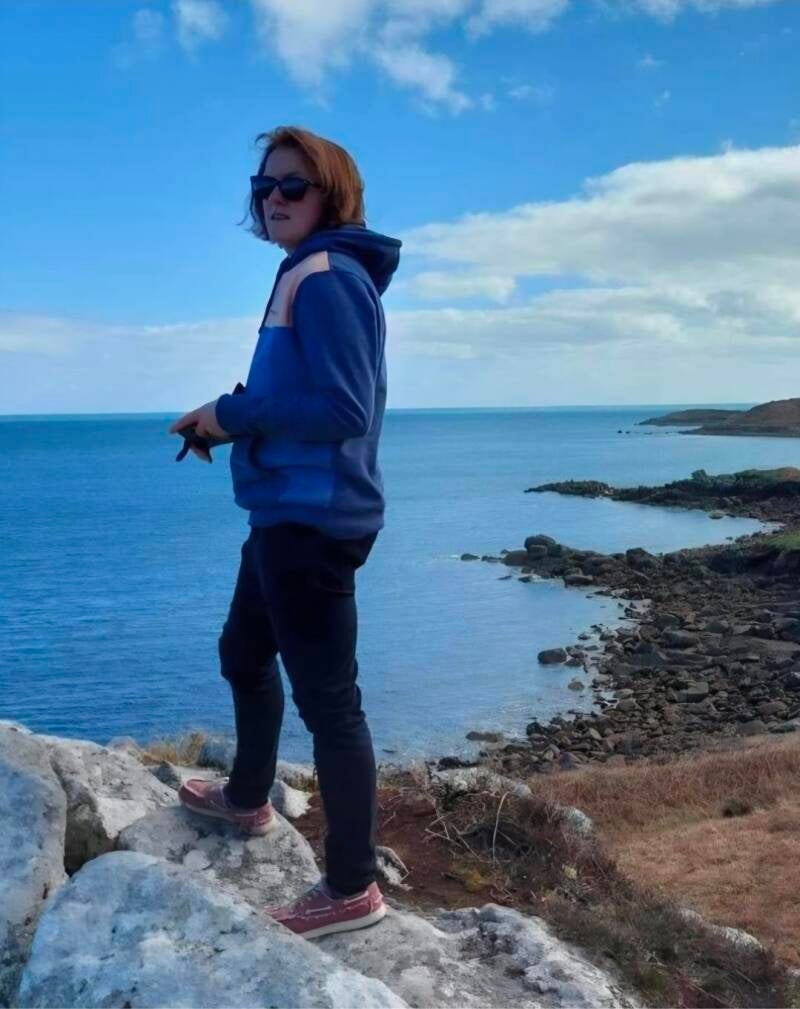
I'm back with a new installment in my indie author series! In talking about her series-kickstarter Wolves of Empire, L. E. Garrison has kindly waxed lyrical with me about the decision to go indie, the satisfaction of writing more mature characters, and wardogs.
This interview is spoiler-free!
Tamara: If I may, I'd love to start with a simple yet weighty question: What led you to choose the indie route? What did you expect and not expect from undertaking it?
L.E.: Although I never actually queried in earnest, I was originally dead-set on traditional publishing. I equated trad with success because I hadn’t properly explored the indie route at this earlier stage.
However, I became increasingly put off by the general consensus that debut novels need to never exceed a certain word count (for epic fantasy, it’s generally a maximum of 120k words, and Wolves of Empire is 158k). My original critique partner, who read through a much earlier draft of WoE several years ago, kept highlighting the benefits of indie, focusing on the control I’d have as the author, and the fact I wouldn’t need to try to edit my book down to get it beneath an arbitrary limit.
I think it really clicked to me when I went back through WoE for another self-edit about two years ago and ended up adding about 20k words to the draft (after slimming it down in preparation to query literary agents the year before). This was the version I loved the most, because I’d given myself more space to write and worldbuild, and no longer thought about the trad publishing word count. So, in the end, it’s all about personal control and creative freedom, something that indie publishing champions.
What fully cemented my decision was starting to post chapters of WoE and its sequel onto the website Royal Road. I enjoyed the creative control too much to ever consider querying this series. And officially self-publishing Acts of Deicide as my debut back in March set me on this path permanently.
I had no real expectations going into indie. I knew it would be difficult, and that social media would be an absolute chore to get the hang of (speaking as someone who does very little social media even in their free time on personal accounts). What I certainly didn’t expect was to make as many friends as I already have, nor to find such a supportive and lovely community. Writing is a lonely business, for the most part, but indie publishing certainly isn’t.
T: Speaking of Acts of Deicide: How do you feel writing something self-contained has influenced your series-writing?
L.E.: As much as I love Acts of Deicide and will always adore it as my debut, it made me realise that a longer-running series is where I truly enjoy the art of writing. In a way, writing AoD made me fall back in love with Infinite’s End during a point in my life when I was doubting myself and my series the most.
Blue and Sarai from AoD will forever be characters I treasure, but I don’t get to keep coming back to them the way I do with the WoE characters.
T: Moving on to the series in question, could you talk a little more on your decision to write multiple books in the Infinite’s End series before releasing the first?
L.E.: I had very little confidence in my own writing, especially as I was writing the first draft of Wolves of Empire, the first book in the series. So waiting until I’d written the next two books not only gave me time to improve my craft, but also to find my confidence and start to believe that WoE was worthy of being read. I’ve been working on Infinite’s End for about nine years now, so my writing has improved dramatically (I hope!).
I’ll also admit that the series began shifting and changing as I progressed, and things cropped up in Books 2 and 3 that required minor changes back in Book 1, changes I could make because I’d yet to officially publish anything. Also, during the writing of Books 1-3, I was working part-time, with a decent amount of free time to dedicate to writing. As of now, I work full-time and haven’t been able to write anything of serious note in about a year. In a way, I’ve given myself a bit of a head-start and allowed myself to slow down on the series because of how much of it I’ve already “banked”.
And, because it’s definitely worth stating, I sincerely don’t want to be one of these fantasy authors who starts a series, gets people invested, and then seemingly abandons it for years on end with no new release in sight. I love A Song of Ice and Fire with all my heart, and it was the series that got me into writing fantasy in the first place, but the lack of Book 6 for more than a decade is now notorious, and it’s led to fantasy readers being understandably dubious of starting unfinished series. By making it clear I’ve already got half the entire saga written and ready to go, I’m hoping to avoid putting off potential readers who are still sitting there waiting for The Winds of Winter.
T: This leads us quite nicely into my next question: Do you write linearly, or do you jump around?
L.E.: Linearly all the way. I need to know exactly what precedes a scene so I can ensure all the context is consistent.
T: And do you consider yourself a gardener or an architect? (Or, if you like, planner, planter, or pantser?)
L.E.: Architect all the way! I’d love to be someone who can dive right into a story idea and discover it along the way, but I literally can’t function if I don’t know exactly what I’m writing, where the story is going, and what individual scenes I need to tackle next. I usually have a “plot plan” document for each book where the individual chapters are broken down into a chunky paragraph summary, and those documents usually end up running to around 10k words alone!
T: Which part of the writing process do you enjoy the most? Which do you dread?
L.E.: I really enjoy the first pass-through after the first draft, when the skeleton of the story is in place and I get to focus on putting some meat on those bones! The bit I dread is the initial plotting, simply because I’ve just never been very good at hashing out a plot first try and end up getting bogged down and disheartened by my own decisions!
T: Similarly, shifting our focus back to Wolves of Empire in particular, was there a sequence in WoE that you absolutely loved writing? Was there one was that was a struggle?
L.E.: I enjoyed writing all the Endarion-Estrid scenes, but my standout was definitely the scene where she confronts him in his room at Dujaro during the war negotiation. I had such a blast packing all their fraught romantic history into their exchange, and there’s something about the “killing you or bedding you” dialogue that made me feel like I nailed their dynamic (pun intended).
The final battle between multiple armies outside Varanos was the biggest struggle, purely because of logistics. I couldn’t get into a full writing flow because I had to keep consulting my notes to make sure the numbers and armies were all adding up and where they needed to be. So many moving parts!
T: I personally would find the prospect of writing full-on, realistic military campaigns daunting. How do you keep all those technical details straight? Were there any specific resources you leaned on? Was it difficult to balance the human, relatable element with the broader movements that drive the plot?
L.E.: Lots of notes for keeping the details straight. I used physical notebooks for these so I could easily consult figures and troop movements as I was writing. Sometimes I’d even draw diagrams so I could visualise specific battlefields (especially that final fight outside Varanos, which involves ten different armies going at it).
For resources, I read historical biographies on Julius Caesar, Napoleon Bonaparte, Alexander the Great, and Hannibal Barca. I also read Caesar’s own account of the Gallic War to get a sense of how the man in charge would view a battlefield, and it was quite enlightening. I also had a quick skim of Sun Tzu’s The Art of War.
I found it fairly easy to balance the human element with the broader plot movements. Using third person limited POV allowed me to keep things close and focused with Endarion and Estrid (for battle/military sequences), meaning I could capture the smaller moments (Endarion wiping a bloodied hand through his hair and beard mid-fight, for example), to highlight the wider brutality of the conflict itself.
T: I loved all your characters and the variety of relationships you portray, but Endarion and Estrid were a stand-out for me. Not only because of their romantic history and its very real consequences on the world at large, but simply because they were older. Were their ages and relationship a conscious decision, or something that happened organically as you wrote?
L.E.: I’m so glad their relationship has resonated! Both their age and their complex history were conscious decisions, and one of the earliest things I planned in the whole series. I’ve always adored the possibility for complexity with older characters, as they have more backstory by virtue of having lived for longer and experienced more of the world. I also really love messy, engaging romances, especially those that dabble in the whole enemies-lovers territory, so thought it was a perfect opportunity to combine both of these things with Endarion and Estrid. There also isn’t a huge number of older romances in the fantasy genre, so I guess I wanted to do my part to try to add a ship-worthy pair to the space.
T: Endarion is of course at the heart of the Boratorren family. Was there any particular inspiration for the dysfunctionality of the Boratorrens and their extended family, which in a way includes Estrid?
L.E.: Certainly not my real family, because we’re all annoyingly well-adjusted! A major inspiration for the Boratorrens and their fractured nature was definitely A Song of Ice and Fire (minus the incest, of course), and the Chronicles of the Unhewn Throne trilogy (which has a very heavy focus on three siblings who kinda hate each other). I also just really liked the idea of writing something so unfamiliar to me personally, and so approached it as a challenge to myself.
Also, I think we can all agree that stories are more interesting when people aren’t getting on! There’s no conflict if everyone is friends.
T: Another compelling feature of WoE was your magic system. We’re both lovers of holistic, environmentally-intrinsic magic, so it was little surprise I loved aasiur and the Shroud. Were there any other fictional magic systems that inspired you? Contrastingly, were there any that you wanted to avoid emulating?
L.E.: I’m pleased to hear that the magic system works well. I’ll admit to being somewhat inspired by the concept of Shadesmar in the Stormlight Archive. I loved the idea of magic originating in another plane of existence, so that’s sort of where the Gnostic Planes come from. Although the aasiurmancy magic system is, at its core, elemental, I wanted to try and avoid including a basic, four-elements magic, because it’s been done plenty of times before and I’d have nothing new to add. This is why I eventually formed a magic system that revolves around the idea of nine different branches, with five of those branches being additions to the basic four elements.
T: In addition to aasiur, we’re given tantalizing glimpses of other worldbuilding concepts, from airships to additional races to other planets. Was it difficult to hold back delving too deeply into these in WoE?
L.E.: So bloody difficult! If I wasn’t so aware of word count and wanting a slightly slimmer first entry into the series, I would’ve gone full worldbuilder and fully explored all these ideas I hint at. I also don’t want the story to grow too expansive to the extent that I struggle to keep everything balanced, so there’ll be certain things (like the other planets) that will be developed slowly even in the sequels.
T: And perhaps on a more mundane level: It can be difficult to wrangle larger-than-life, intelligent animals, even in fantasy where we theoretically have all the control. What made you decide on wardogs? Was there any special research that went into writing them?
L.E.: I am a lifelong dog lover, and have three dogs of my own, so had to include canines in some way. I also think the idea of 1,000 armoured war dogs thundering towards you on a battlefield is metal as hell! As for research: I just watch my dogs interact and sometimes Google what their body language might be conveying. I then just reframe it slightly, because my 9kg pug-cross certainly isn’t a slavering wolfdog!
T: To take a step back, now, and look at WoE as a whole: What impressions do you hope readers come away with? What can they expect from subsequent installments?
L.E.: I hope readers come away with an impression of a massive world absolutely full of conflict and complex characters, with a larger threat looming in the background, pulling the strings. That threat will shoulder to the forefront in the sequels, and readers can also expect further development to characters and their dynamics, and a lot of time spent in the magical empire of Drasken courtesy of Tali’s arc. The series will become slightly more surreal and esoteric as it progresses, and magic will have more of a central role as the conflict heats up.
Also, characters will die. So expect some MC death!
T: Consider me warned! In light of how much work you've put into this series already, do you have any advice for aspiring writers?
L.E.: My number one piece of advice would be to write absolutely any idea down, no matter how silly you might find them. And, once you’ve written them down, give yourself time to explore them before deciding whether or not to set them aside or pursue them fully. My biggest regret as a writer is abandoning ideas that probably had promise purely because I didn’t have the patience to stick with them for the time they deserved.
T: In the same vein, but from more of a readerly angle: What’s one thing you wish the layperson reader understood about the indie publishing scene?
L.E.: That just because it’s not published by a massive publishing house doesn’t mean it’s not fantastic. Indie books can often be better because of the freedom and creativity involved, and a book being self/indie published isn’t a sign it was rejected by trad publishers and that this is the author’s last shot at publishing. For more and more indies, myself included, self-publishing is the first real choice.
T: Thinking about the rise of indie publishing, and now hybrid publishing, with trad-pub trying to adapt to both, do you have any thoughts about what the future landscape of publishing might look like?
L.E.: I think (and hope) that indie publishing will continue to grow in popularity and only become larger. I also think it’ll start setting the trends that trad will be sprinting to keep up with. I’m also hoping publishing (all forms of it) will turn fully away from AI in creative spaces, and the staunch opposition most indie authors have to AI is a good sign that this is the direction we’re heading in.
T: And you're very firmly in the indie scene – you’re an active reviewer as well! Have there been any pleasant surprises from your TBR so far this year? Do you find it tricky to switch gears between reader-reviewer mode and writing mode?
L.E.: Since starting to self-publish, I’ve made it my unofficial mission to read more indies, so I can better-exist in the space and help support my fellows. Having not read many indie books at all prior to publishing my debut in March, I’ve been pleasantly surprised by pretty much everything I’ve read this year and am still astounded at the creativity and craftsmanship on display.
Particular highlights are of course your Stone and Flesh, which I came to after reading and loving the prequel novella. I also adore Chantelle Fourie’s The Burning Grasses, Bill Adams’s The Godsblood Tragedy, T. J. Hassall’s Blood of the Banshee, both of Abel Montero’s Memories of Kenjir books (champing at the bit for Book 3!), and Donna Morgan’s Ember and Steel (one of the first indie fantasies I ARC-read).
As for switching gears, I do find it quite easy. I was a reader long before I was a writer, and almost all writers are readers anyway. Studying English Literature and Creative Writing at university has also helped me hone my reviewer brain and keep it separate from my writer brain. When reviewing other indies, though, I do take care to only post and showcase positive feedback. Even if I’ve got criticisms, I will always sandwich them between mountains of praise!
T: That's very kind, thank you! As we start to round up, let's ask what might be a divisive question for us readers: Hardback, paperback, eBook, or audiobook?
L.E.: Hardback or paperback for me! I struggle to concentrate and take information in if I’m reading an eBook, and that’s even worse with an audiobook. I very much prefer having a book in my hands, able to skim back and forth with ease, enjoying that very particular smell new books have.
T: We're in agreement, there. And finally, a little whimsy, as is my way: Would you like to be a mage? If so, what type of aasiurmancy appeals to you the most?
L.E.: Absolutely! Boring answer: I’d be a worldstrider so I can cut my work commute down to five seconds by hopping through a portal between home and job! Fun answer: I’d be an aeromancer and master self-powered flight.
Big thanks to L.E. for having this conversation with me! Wolves of Empire releases November 16th – see below for details!
Wolves of Empire is the first book in the epic, world-spanning Infinite's End series. Grimdark and military fantasy fans will delight in the large-scale stakes and visceral experiences that leap off the page, but there's plenty of quieter, simmering tension and magical elements to engage those who prefer a more intimate theater.
The world has known precarious peace for generations, but the unexplained assassination of one powerful noblewoman unveils an immortal conspiracy more than ten thousand years in the making.
Endarion and Estrid, jaded generals who share a complicated romantic past, are drawn back onto the battlefield when the opposing empires they serve declare war. Once lovers, now rivals, they are each the other’s greatest enemy.
Meanwhile, in a viper’s nest of a city older than humanity itself, Endarion’s niece Sephara hunts down the assassin in hopes of halting the conflict before it can engulf the entire continent. Her investigation will force her on a collision course with backstabbing nobles, immortal rulers thought long dead, and assassins who wield the very shadows themselves.
Across the continent, bastard-born Tali, Endarion’s youngest daughter, awakens to a magic long thought eradicated. But her powers make her a target to powerful immortal factions; perhaps the same immortals her family now unwittingly fights against.
As empires war and the immortal creators of humanity emerge from supposed extinction, one family is dragged into the centre of a planet-spanning conflict.
Can't wait for the launch of Wolves of Empire? How about a standalone to whet your appetite?
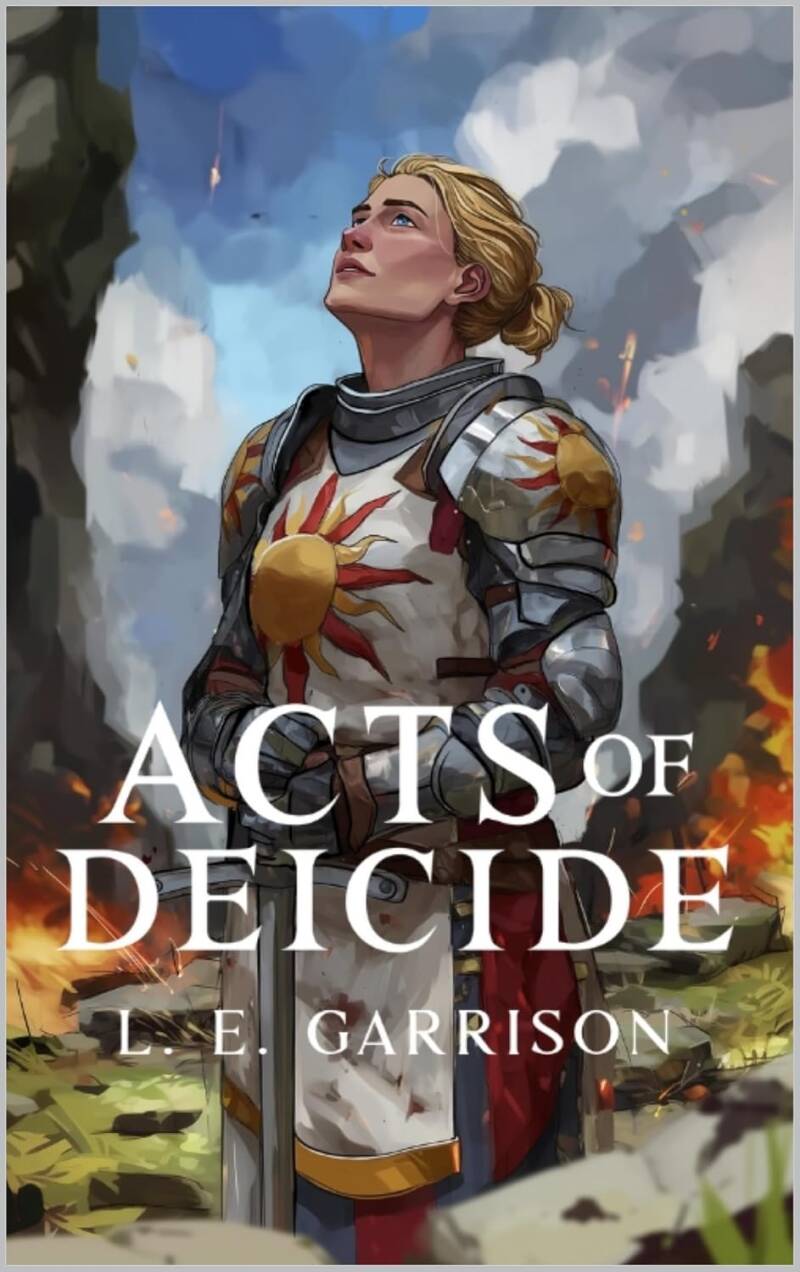
Acts of Deicide is a standalone novel – perfect if you're between series but still want to scratch that dark fantasy itch.
300 years ago, a god was murdered.
Blue, once the deity's most faithful general, made immortal through her service, has wandered the fractured land ever since.
Her inability to die is a curse she strives to end.
Chance has her collide with Sarai, a guard captain who possesses an ancient memoir detailing the events of the god's death. If Blue can find the weapon used in that divine assassination, perhaps it can end her life, too.
Fuelled by a death drive developed over centuries, Blue seeks out the blade with Sarai at her side. Their hunt will take them across the blood-soaked extents of the broken empire, where the violently faithful battle for the right to name themselves the next God-Emperor.
But a blade that can kill one god can also make another, and Blue isn't the only one who desires that weapon.
Acts of Deicide is a dark, visceral fantasy that explores immortality, the unreliability of memory, and the nature of faith and godliness in a world destroyed by the death of its divine ruler.
Tamara receives no compensation, financial or otherwise, for these interviews. Neither is she responsible for the content contained in external links.
However, if you enjoy these interviews, you can always buy her a coffee!
Add comment
Comments