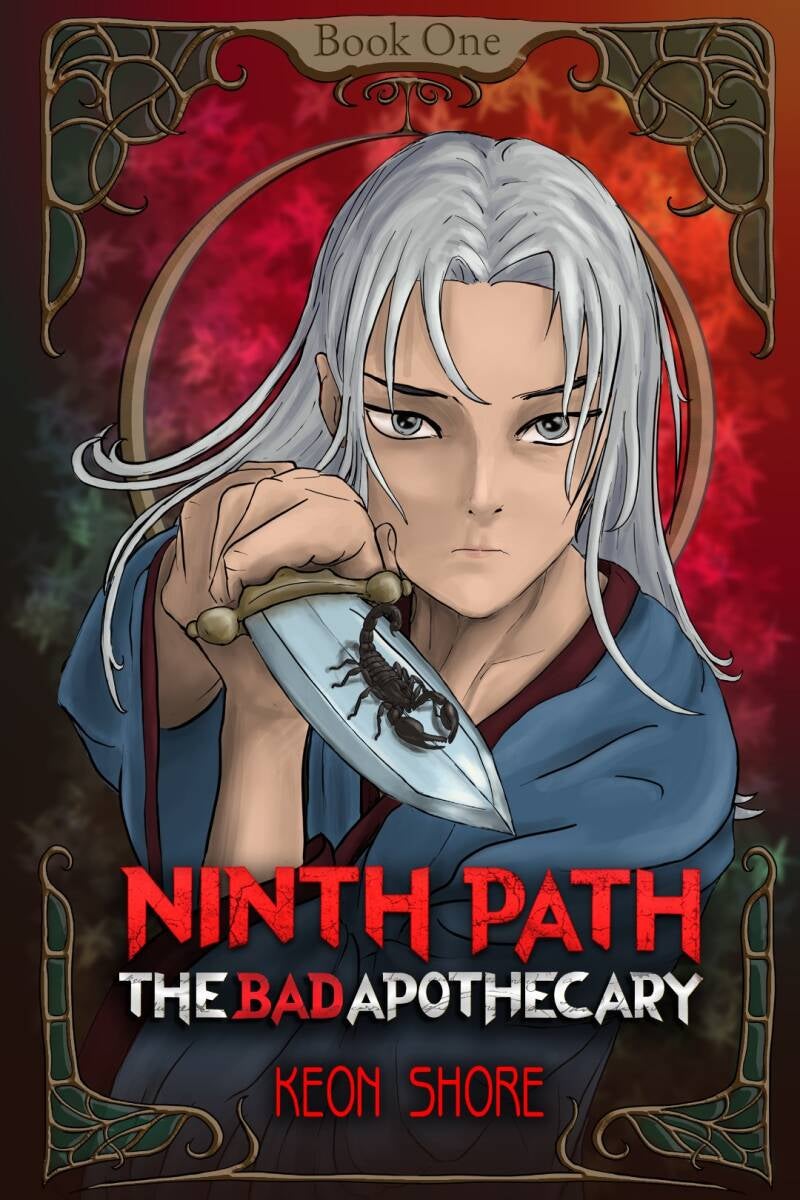
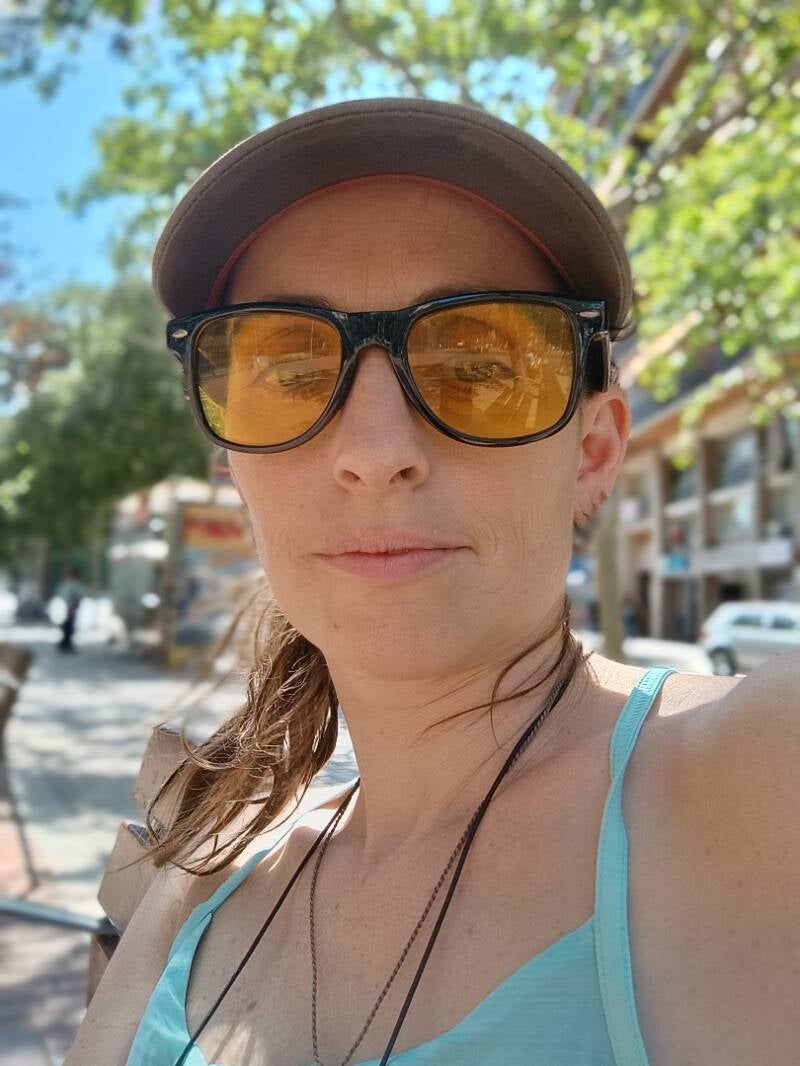
After a brief respite, I return with another conversation for my indie author series! My latest partner in this endeavor is the passionate and well-traveled Keon Shore. She's graciously indulged my interest in her debut novel The Bad Apothecary, and we make an honest exploration of the joys and challenges of genre, especially in the self-publishing world.
This interview is spoiler-free!
Tamara: I must always begin with what intrigues me most: your inspiration. What began your love for Asian culture? Was any part of it a particular inspiration for embarking on Ninth Path?
Keon: I’ve been in love with Asian culture since I was a kid. I can’t explain why. I just loved kung-fu movies, green tea, martial arts, later anime and of course the food. My dad had an audiobook of the Dào Dé Jīng which we’d listen to for breakfast on repeat... Later I visited China, Japan, Indonesia, Thailand and Singapore – not the longest list, but I did live in Indonesia for about two years. My discovery of C-dramas was probably what influenced me most to write a story with that kind of flavor.
Then Chinese webnovels found their way onto my reading list and I loved the less fixed form of storytelling, with short chapters that felt very episodic and punchy. That’s what inspired me to write. I can’t say why exactly but it gave me the freedom to write what I wanted, where somehow before that I kept stalling after the first few chapters of a started project. The style was liberating for me.
T: Speaking of style, let's dig into that a little more. Writers are oft categorized into 'gardeners' or 'architects', or more recently, planners, planters, or 'pantsers': Which are you?
K: Probably somewhere in the middle here. I do usually plan and outline my story but I deliberately leave room in that outline for my ideas to develop and the story to tell me where it needs to go. With my latest novel I added to the outline and restructured parts of it several times in the process of writing, before finishing it, and the climax just kind of emerged out of the stories. I like that – it’s really exciting when you realize, “oh, this is what has to happen, okay, but then where does that lead…” etc. And suddenly you have a turn of events that’s both natural and somewhat surprising even to you as the author. During editing is when all that gets smoothed out to make it really cohesive, but in the first draft I just let it happen…
T: And which part of the process do you enjoy the most? Which do you dread?
K: I love outlining, I love writing, I love the initial editing, and I absolutely love world building. I’ll have several documents outlining in-world elements, history, cosmology (like how the world works internally considering that it has magic). The worst part for me are the late editing rounds where most of the story is good but you’re looking for typos or small stuff and you’ve already read the story like ten times. It’s just not the most exciting part of the process. Similarly formatting isn’t very exciting to me, though it can be quite satisfying when you see the final product.
T: Do you find that you write linearly, or jump around?
K: Linearly. The times I’ve tried to jump around the scenes ended up having to be deleted entirely or edited so heavily that I decided it’s not for me.
T: So to facilitate all of this, what does your ideal writing session look like?
K: Silence, no distractions. If I’m writing a first draft I like being alone and working from my laptop with only one window open. For editing it’s not that important to me. I’ll work parallel on editing, research, worldbuilding and completely different stuff.
T: You have a background in physics, which I find intriguing. Has it influenced your work at all?
K: Probably not in the way anyone thinks. It influences how I think and work, and how I worldbuild but my days as an actual physicist are far behind me. Still, I like having a kind of scientific discipline in my worlds. I don’t write stories where religious factions or others repress the natural curiosity of discovering the laws of nature, so science develops along with human civilization and exists as an important faction within it.
When I design a cosmology with magic I try to come up with a system that’s internally somewhat consistent and can be scientifically explored through observation, where, just like in our world, experiments have the same outcome if you reproduce the same conditions. Magic is just another element, another condition to be met. So how magic works is of course also subject to scientific study, and I usually have a lot of pseudo scientific musings about this, that aren’t necessarily always correct according to my actual cosmology. I absolutely love playing with that kind of stuff, but so far it’s mostly backstage stuff.
T: On the subject of 'scientific discipline', I'd like to turn to The Bad Apothecary specifically. Given the presence of contagion-like afflictions, basement experimentations and magical technology, one could argue there’s a strong sci-fantasy streak in the book and has contributed to, as you’ve said before, your work not fitting neatly into genre boxes. Has this been a challenge, or liberating?
K: Liberating I guess. As I mentioned, I think fantasy should be based on our imagination, not some formula or copy-paste of other stories. I didn’t set out to write another Lord of the Rings or Game of Thrones – that’s just not my thing and not what I wanted to explore with my story. I took my ideas and designed a world around them, without considering industry standard fantasy settings, specific epochs or parallels to our world. Because it’s not our world. I wanted to imagine a world where fossil fuels didn’t exist, but magic could be used to create electricity or motion and other effects. What would a civilization where those things were integrated into the infrastructure look like? Guilds of ‘magic’ workers running the city was one of the main consequences I imagined. They exploit and protect each other. They’re more background in the story at the moment, but they’re there, part of the worldbuilding. I deliberately designed my society to be modern – no annoying patriarchal oppression of women in traditional roles. It just wasn’t something I wanted to explore. So yeah, in that sense it was very liberating. I got to design a world with exactly the aesthetics I wanted and that let me explore exactly the kind of themes I wanted to.
It’s hard for me to judge whether this is a marketing challenge or not, because I have no comparison. It could be that I just majorly suck at marketing, and even if I’d written the most to-market book in the world, I still wouldn’t know how to sell it. But sure, keyword placements and setting expectations for readers is tough when the closest comp titles are nothing like my story and I flail around trying to explain to pitch it.
T: That feeling of liberation is one of the great rewards, I agree! Following from that, was there a sequence in The Bad Apothecary that you absolutely loved writing? Was there one that was a struggle?
K: I absolutely loved the scene where they go into the vault with Reik and everything that happens subsequently. It was so fun and I think it’s still my favorite scene in the book. I generally go by the rule that if I really struggle with a scene it’s probably not meant to be in there / there’s something wrong with it. Once I figure out what it is, the writing flows smoothly again. So you won’t find any scene in there that I really struggled with.
T: There’s a lot going on beneath the surface of this story, which I love. How do you keep track of your worldbuilding, plotting, and so on? Were there any particular topics that you researched?
K: I have an entire folder full of outlines, character arcs and backgrounds, ideas for interactions, worldbuilding notes, dissertations from fictitious in-world scientists, the magic system with all its levels and lineages, how the world really works, and how it’s misunderstood by the most common factions and what the consequences are to that. I’ve got everything written down somewhere. That doesn’t mean I necessarily go and reread that stuff, but it’s there if I really need it. I haven’t found any tool to mindmap this stuff and I don’t think I will. So far just keeping searchable notes for the important characters and plot points has worked alright for me.
T: Your pacing is masterful! You seem to know exactly how to drip-feed information to the reader. Were there ever times that you agonized over whether to keep or discard something when drafting? Was there anything, for example, that was originally intended to be in The Bad Apothecary that has since been saved for later books?
K: Thanks! I’m flattered.
So, when I wrote the first draft I wrote about 600k words (and that’s about halfway through the first big story), then I took the first 100k or so and rewrote them to be a more self-contained story: The Bad Apothecary, at 150k words now. Needless to say, there are some open ends in TBA that come together in Extraordinary Ruin [the upcoming sequel] or even later. I introduce characters early on but TBA ends before they actually become relevant again. This was always one of my main concerns – that it would feel like unrelated sidequests to readers, when really it was important groundwork. So, no, I didn’t discard these things, even though I know some might see them as flaws. I didn’t want stuff popping up out of nowhere with this story, as if invented on the spot. Almost everything is connected from the start – well, retrospectively at least – but it’s not necessarily evident.
T: In addition to the pace, one of the strongest aspects of The Bad Apothecary for me was the relationship between Diwu and Nex. Regardless of whether that relationship later blooms into a romance, I loved how the development of trust between them was so gradual and organic. Was this intentional from the get-go?
K: Yes. I’m not a big fan of dynamics that come out of nowhere. If the characters are willing to sacrifice for each other, there has to be a reason for it. It’s just so much more rewarding when you know what drives their loyalty for each other. Not necessarily a specific event but the process of deciding that this person is worth it. I really wanted to have that. In my original outline Nex didn’t even exist, and Hal was supposed to be a kind of mentor figure. But it just didn’t work. There was no chemistry, no bonding, it felt artificial. I decided to rearrange things and Nex just kind of emerged, while Hal turned into what he is now, which I think gives a really nice spectrum of dynamics.
T: What impressions do you hope readers come away with? What can they expect from its sequel, Extraordinary Ruin?
K: Extraordinary Ruin for me is where the big story really starts unfolding. The Bad Apothecary is like an introduction to the characters and world, but the story that’ll pull Diwu and Nex through some real growth only starts in Book 2. It’s complex and obscure, but it’s also exhilarating and tense and we do get a few answers, a few insights that build promise.
It’s hard for me to comment on what I want readers to come away with. I hope they get the themes I’m exploring and the angles I’m employing. But the point of story telling is that these things aren’t explicit. I don’t go and say: this story is an allegory for X and Y. One of my main ambitions was to break with the traditional idea of antagonism, i.e. the “we must fight the villain/ancient evil/bad something” trope. I wanted to make things more fluid where whatever game is being played might not be about winning or losing, nor about destroying that which appears to be a threat. Instead of this last-man-standing idea, there’s something else.
T: You've clearly been hard at work on polishing Extraordinary Ruin, but you've also been working on a separate standalone project, The Verdant Complex. Has it been difficult to juggle two projects?
K: Not really, since I deliberately benched Ninth Path’s third book to focus on Verdant Complex. This has various reasons, one being simply needing a break, a fresh look at the story to see how I can improve the flow from here. I’ve got a lot of material already written but it’s missing some beats, some proper structure and variation in tension to make it work. There are a lot of strands I’m tying together with sub-arcs that are really important and fun, but they need to be managed the right way, otherwise none of them will really stand out and things will just be confusing. So I wanted to step back and look at something else for some time.
The other main reason was that Ninth Path really hasn’t found a loyal readership and while I’m absolutely determined to continue it, it does sometimes feel a bit like I’m beating a dead horse. That’s incredibly demoralizing. So I wanted to try a different horse for a while. With my stunning marketing talent I’ve no doubt where this one will end up, but at least I get another dopamine fix of completing another novel.
T: Are there any features of the Ninth Path series that readers will also find in The Verdant Complex?
K: The Verdant Complex leans into the idea of paradigm shifts and uncommon solutions to a threat that in the standard fantasy treatment would be fought and destroyed by bigger and better weapons. So in that sense it’s got similarities to Ninth Path at its core, but I think it’s far more explicit in what it does. Apart from that and on the surface, they’re very different stories with very different magic and a very different threat.
T: We've touched on the challenges of self-publishing briefly, so I'd like to pivot there next. What led you to choose the indie route? What did you expect and not expect from undertaking it?
K: My book is too long for trad publishing, I didn’t even try. I didn’t expect the black hole I’ve found visibility to be though. I mean, I didn’t go in thinking I’d become famous overnight, but I did have the illusion that I’d get some readers/buyers. In the end it’s been zeros all the way down for the most part and it’s been hard on my morale because I didn’t just write this on a whim.
T: What’s one thing you wish the layperson reader understood about the indie publishing scene?
K: Word of mouth means everything.
T: Thinking about the rise of indie publishing, and now hybrid publishing, with trad-pub trying to adapt to both, do you have any thoughts about what the future landscape of publishing might look like?
K: No idea. I feel like indie publishing is such a great opportunity for the world to have access to stories that publishers might have rejected for various reasons that have nothing to do with the quality of the story – from political to economical. I hope this opportunity continues to exist and that visibility improves for independently published works, but I doubt that’ll happen. With AI books on the rise the market is just flooded and no one can connect to anything anymore, unless they follow the engineered trends. It’s censorship by economic power (because marketing costs money). Stories are silenced by obfuscation.
T: Do you have any advice for aspiring writers seeking to try their hand at Asian-influenced fantasy?
K: Well, that’s specific. I think you just have to love the culture to want to write a story that’s informed by it. I didn’t even know Asian fantasy was a thing until after I’d been studying Taoist texts and practicing Taoist yoga (daoyin/neidan/qigong) for some time, while living in Indonesia, and when I saw references to Taoism in fantasy (wuxia/xianxia/Xuanhuan) I just fell in love with the genre. Apart from that though, what really got me was the unusual dynamics between characters that this cultural influence brought about – it was refreshing to me, because the stories, at least initially, were completely unpredictable. From honor suicides as a normal thing, to blood brother pacts happening between people that just met, supposed villains that turn into the best allies and my favorite trope: the righteous hypocrite, where wrongdoings are disguised using terms like “upholding the Dao” or “cleansing evil”.
To me these story and character dynamics were inspiring and while I wouldn’t say I used many of them one-to-one, they influenced my idea of character and plot dynamics. Other Asian-influenced stories focus on other themes entirely, like historical and cultural accuracy, portraying a world that’s similar to actual imperial China. That was never my intention. I preferred to create something based on the abstract and philosophical ideas that I found and loved in Chinese fantasy and let those influence the world building from within, but actually let the world evolve instead of recreating something. Not sure where that leaves me in terms of advice I could give.
I guess: study some of the prominent and classic works in the various subgenres and see what core principles call to you. Then use them. As someone who doesn’t write according to scripts or formulas I strongly believe we should use our imagination to the max when creating fantasy. I mean…invent your own architectural styles, musical instruments, governmental systems and folk traditions or whatnot, based on your world, not what other authors have envisioned or what our world looked like.
But if it’s supposed to be Asian-influenced you’d think of that influence as a core everything is built around. What philosophical element drove the design here? Taoism for example loves circles, but there are also the eightfold symmetry and the five fold symmetry. You could imagine Taoist influenced architecture to have elements of those symmetries in them. Plus curved eaves. Those are a must. This is how I went about things, though I put another step in between. I designed my own cosmology and various philosophical frameworks based on Taoism, but with some alterations, to accommodate magic. In my world the three- and ninefold symmetry for example is predominant and I’m not using any actual Taoist terms or concepts, only vaguely leaning on them.
Influence, especially such a rich and deep one as Asian culture, would of course reach into much more than just the worldbuilding. Let’s take the yin and yang for example – an incredibly important concept outlining how no pure states exist according to Taoist philosophy. There is no absolute evil, there is no absolute good, black and white contain parts of each other and form a whole. A story/plot that doesn’t somehow reflect that has missed a big chunk of Asian philosophy. It’s an opportunity, not a must, of course, but you can imagine villains and heroes might contain parts of each other in some way, complete each other in some way or show tendencies of ‘the other side’... How that’s crafted into a story is of course the real art, and my preference is to lean into the subtle or implicit.
T: Speaking of other Asian-influenced stories, here's a question on behalf of readers: Do you have any recommendations for other cultivation, or Asian-inspired fantasy, books/media?)
K: Lord of the Mysteries was one of my favorite Xuanhuan fantasy webnovels. It’s not cultivation, it’s more progression fantasy, written by a Chinese author though set in a strange retro-futuristic steampunk London-esque world. It’s absolutely brilliant.
The classic Wuxia novels by Jin Yong (e.g. the Condor Trilogy ) are also fantastic and are really where anyone interested in Chinese fantasy should start. While maybe controversial, I recommend the unofficial fan translation you might find flying around the web over the professionally translated ones you can buy off Amazon – because the official translation sucks. Sorry, but it took all the life out of the writing. The fan translation keeps many of the Chinese terms (like Shifu) and the colorful curses, so it reads very differently and feels closer to the character of the cinematic adaptations I’ve seen.
T: As we start to round up, I'd like to turn briefly to another of your 'ventures', if you will. You also review books on occasion, and rather than the standard star-rating, you use your own. Could you tell us more about the RESCS and why you developed it?
K: My Reader Experience Story Craft Spectrum (RESCS) was intended to avoid assigning a subjective and kind of arbitrary numeric value to a book as a rating to say whether it was good or bad.
Instead it gives me various axes along which the story can be weighed or placed, giving the potential readers an idea of what the reading experience might be like for them. It’s obviously still subjective, but it cuts out the one-dimensional good versus bad evaluation and turns it into something more rounded out which, at least in my opinion, does a bit more justice to the stories, and becomes detached from my personal preferences. E.g., I might not have liked the book but the pacing was still fast, and the prose was still excellent. Star ratings can’t contain that information, and I find they turn writing into popularity contests rather than a valid form of art and expression. So by using RESCS I try to honor storycrafting and support other authors and their stories.
T: Finally, I'd like to indulge in a little whimsy! What Path would you choose for yourself and why?
K: I’d probably want to be White Path, informationist lineage. They have mentalist-like abilities but can also use information as weapons, like scrambling information/thoughts in your head or blocking/scrambling information in your CNS. They can ‘read’ information through subtle patterns and extract it almost like mind-reading, and they can block information from being transmitted or received. They can understand foreign languages and communicate through unconventional means. It’s a pretty fun but subtle lineage.
Or maybe Blue Path, unchained lineage. They have abilities that make it very hard to contain them. Their bodies become unnaturally bendy, locks open upon touch, they can slip bindings, and in terms of offensive, they can make things leak. Yes, that includes the enemy’s blood vessels. They have some limited control over space, distorting it under certain circumstances.
Big thanks to Keon for having this conversation with me! The Bad Apothecary is out now – see below for details!
The Bad Apothecary is the first entry in the Asian-inspired, gritty Ninth Path saga. There's plenty here to hook any fantasy reader: an intricate but never heavy-handed magic system, rich worldbuilding, and compelling characters to name but a few, all set to an accomplished pace. If you're new to the cultivation fantasy or wuxia-inspired fantasy subgenres, this is a great entry point! The sequel, Extraordinary Ruin, is out later this year (and Keon's looking for early readers...).
Diwu stumbles into the capital half-dead, wounded by something no healer can cure. Nestled in her flesh is a strange pathogen carrying corruption, the antithesis of the Natural Order.
Desperate, she trades freedom for survival and falls into the grip of the Hierarchy, a ruthless organization that keeps power in check by any means necessary. Their treatment in exchange for loyalty. Service. Obedience.
Her first assignment entangles her with Nex Teres, a battle-hardened cultivator with no interest in playing agent. But the Hierarchy doesn’t ask—it coerces. Bound by duty and circumstance, they’re sent to a lawless outpost where Diwu was first infected, and where the name of a long-dead legend has the Bad Apothecary.
Tamara receives no compensation, financial or otherwise, for these interviews. Neither is she responsible for the content contained in external links.
However, if you enjoy these interviews, you can always buy her a coffee!
Add comment
Comments