I'm continuing my indie interview series with something a little different! Urban fantasy author Mark Engels speaks with me about his Forest Exiles saga, the unexpected turns a publishing journey can take, and the challenges and rewards of working with artists. As a bonus, if you, like me, are new to the genre, he has a recommendation or two for taking the plunge!
This interview is spoiler-free!
Tamara: Firstly, I'm dying to know: What inspired you to undertake the Forest Exiles Saga? You’ve cited anime, manga, and anthromorphic fandoms generally, but is there a particular aspect about these that really spoke to you?
Mark: I wrote the books I had in my heart to write, the books I wanted to read and couldn’t find. So it should come as no surprise the main character of my urban fantasy family thriller series was a young woman despite my being a middle-aged man. Because so many of my favorite anime, manga, and anthropomorphic storylines from back in the day are built around a young woman or young women.
T: That leads me quite nicely into my next question: What made you choose a teenage girl for your primary protagonist? Did you set out to make Ritzi a deuteragonist or did it happen by accident?
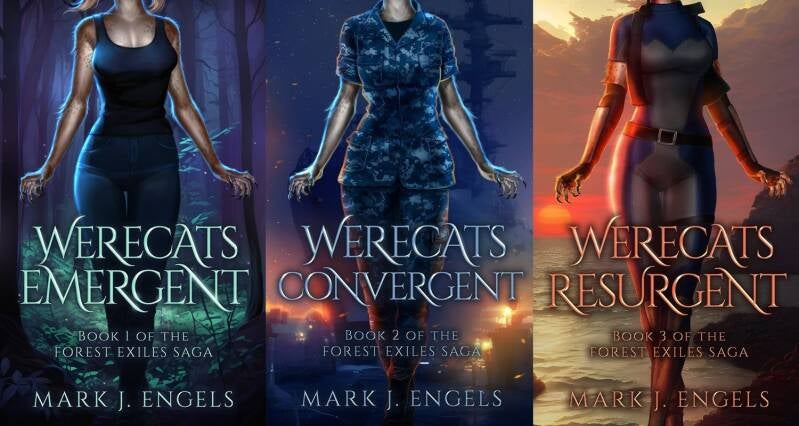
M: Teenage Pawly being my protagonist was a hat tip to several of my favorite anime, manga, and anthropomorphic franchises. Ritzi became a deuteragonist in Werecats Emergent because of feedback I had received from the release of an earlier book called Always Gray in Winter (which was edited and re-released as Book 2 of my Forest Exiles Saga, titled Werecats Convergent.) In Gray (and still today in Convergent and Book 3, Werecats Resurgent) I rely on multiple POV characters to allow the reader to see the story unfold. Some readers of Gray reported they found the multiple POVs confusing.
So when Gray came off of contract with the small press who had published it, I knew I wanted to finish the rest of my series and relaunch it with a different book at Book 1. I thought one way to make my new Book 1 more accessible to readers was to limit the number of POVs. Some books, especially urban fantasy books written in first person, rely on only one POV–that of the main character. You know enough about the storyline having read Werecats Emergent that that wouldn’t much work for the sort of story it is, so I settled on two, those of both Pawly and her uncle Ritzi.
T: That's quite the journey! It seems to me that this may have contributed to you choosing the indie route. Is that right? What did you expect and not expect from undertaking it?
M: After getting little traction with agents, I started looking at independent presses, including some established outfits and smaller, start-up ones. My experience with Gray at one small press startup led me to conclude there wasn’t much they were willing or able to do for me to edit and publish and market my books that I couldn’t do–and do better, frankly–myself. I am glad and grateful for the friends I made along the way, for they would become my pre-readers and trustworthy information sources which I would need to figure out how best to do all the things necessary to draft and edit and publish and market my books.
T: Thinking about the rise of indie publishing, and now hybrid publishing, with trad-pub trying to adapt to both, do you have any thoughts about what the future landscape of publishing might look like?
M: No. Because who can say what works today will work tomorrow? My experience suggests that many of the people who would are trying to sell you something.
T: If I may, I'd like to hone in on your writing process next. Can you describe your ideal writing session?
M: Evening between the time I have Done All The Things and the time I’m so tired I can’t think straight anymore nor keep my eyes open. Though I keep notepads in every room of my house because I never know when inspiration might strike to answer a knotty plot conflict or character motivation conundrum.
T: Which part do you enjoy the most? Which do you dread?
M: Despite being a planner, I dread the outlining, because I believe it critical to burnish the narrative first before progressing. I want for the narrative to make sense to me before I set about the task of further developing the narrative so that it makes sense to readers. I enjoy the editing after the drafting, because I’ve completed the first order tasks of “get the story out” and “get the story down” and am at that point ensuring that I “get the story right.”
T: Do you write linearly, or do you jump around?
M: When I draft, linearly. Because what comes before impacts what comes after. When I edit, though, I do skip around, because this change here is preceded by something that may need changing and followed by something that almost surely will.
T: Your work has been praised for its “breakneck” pace. Do you find keeping that pace comes naturally, or are there certain techniques you employ to sustain it?
M: I had read somewhere during my research that each chapter, each scene, each paragraph needs to serve multiple purposes–describe the setting, advance the plot, develop the characters. It ought not ever do just one nor do just one for very long unless the author is making a conscious decision to do so for effect. Ensuring every part of the narrative is doing at least two things and once led me to develop a fast-paced story without consciously deciding to.
T: That's great advice! And on the subject of advice, do you have any advice for aspiring urban fantasy writers? In general, what advice do you not agree with?
M: I do not agree with any particular piece of writing advice being prescriptive, aside from “writers write” and “figure out what works best for you.” There Are Many Web Sites Which Say Many Things, and the engineer in me was bound and determined to read them all. Much of my work relies upon codes and standards and past practice, so it is incumbent on a practitioner like me to avail myself to them. Which[,] much of that is objective because physics, [and] parts of those are subjective. But nothing like how subjective writing and editing and publishing and marketing are.
All any one resource can say is what has worked or hasn’t worked for them/there/then. Will that work for you/here/now? Who can say. All the more important for a reader to understand who they are, what they’re writing, and who they’re writing for. So they can best implement Bruce Lee’s timeless wisdom “Adapt what is useful, reject what is useless, and add what is specifically your own.”
T: Speaking of resources, what's the oddest thing you researched for your books?
M: Character Stanislaus Katczinsky from Erich Maria Remarque’s World War I-era book All Quiet on the Western Front, a book I’d read during high school which is still today one of my favorites. “Kat,” like a number of my characters, was a native Pole, and it was from his surname that I coined “Katczynski” for my books’ protagonist (though Pawly and her twin brother Tommy were born in the States.) My depiction of family patriarch Teodor “Dory” Katczynski is in large part based on Ernest Borgnine’s portrayal of Kat in the 1979 movie adaptation.
T: One of the things I appreciated most was the wonderful cultural hodgepodge woven into your narrative: Korean, Polish, and something distinctly Chicagoan! How did you choose which cultural details to include and which to omit? Why Chicago?
M: Being I’m a planner, you can be assured I have several enormous files on my hard drive containing links to all my research for all of the above ethnicities and locales. I always asked myself considering any particular bit of information: does this help to describe the setting or advance the plot or develop the characters? If a piece of information would accomplish two or more of those goals, I was likely to include it. If it didn’t, I wouldn’t.
Chicago was an obvious choice owing to my character’s Polish ethnicity and my desire to feature Great Lakes settings both ashore and afloat. I had considering Detroit, given I myself was born and raised in the Detroit area and its preponderance of the Polish diaspora. But Chicago won out, having ethnically Korean neighborhoods in addition to ethnically Polish ones.
T: Speaking of the Lakes, I was struck by the attention to detail any time there was a boat involved in a scene! Do you have a sailing background?
M: I do! This is one of the parts inspired by the life I’ve lived. I grew up in Michigan in the United States near Lake Huron, and my family owned a small runabout which we had out on the Great Lakes and the rivers connecting them many, many times as I was growing up. I loved being out on the water. I went to college near the world-famous Soo Locks on the St. Marys River between Lakes Superior and Huron, and worked there as an intern my last couple years in school. Best job I’ll ever have. I worked aboard and alongside the same sorts of vessels which would later provide the setting for key scenes throughout my series.
T: There's also a strong military theme. Was the inclusion of these elements something set from the start or was it happenstance?
M: That was with specific intent. I wrote my both out of the abundance of my heart and out of the deep, aching longings within it; inspired by the life I've lived and the life I wish I had. I had never served myself, so I saw to it several of my characters did. And a military setting seemed right to me for said characters to organically develop skills in with weapons and in subterfuge and espionage.
T: I always ask this question but it seems particularly apt here, given the amount of research your must have done for all the aforementioned things: Hardback, paperback, eBook, or audiobook?
M: If I’m to retain something, I have to read it. I have almost completely liquidated my collection of hardback and paperback books, being that they were helping no one cluttering up my office collecting dust. Today I read nearly all my fiction in eBook for, save for those paperbacks I pick up elsewhere in the dealer’s den whenever selling my books at a genre-themed convention. “Be the change you want to see in the world”, Gandhi exhorts us, so I see to it I support my fellow indie authors by going out of my way to buy and read and review their books and tell others about them.
T: I loved the family dynamics in Emergent, especially given their circumstances. When you were creating the twins’ dynamic, were you inspired by any other twins in particular?
M: Not particularly. I went out of my way to highlight each of their unique personalities, endeavoring to portray both Pawly and her twin brother Tommy as fully-formed individuals.
T: And is there a character you see yourself most in, if any?
M: Ritzi. Middle-aged, world-weary, rife with regret. In the words of Forrest Gump, “And that’s all I have to say about that.”
T: On a slightly different subject: I’m envious of your gallery of illustrations! Do you feel having art – beyond simply a good cover – is important to a book’s success? What’s it like working with artists directly?
M: I had thought that art would be important to a book’s success, but my experience suggests “not necessarily.” As an example, look at all the top-selling fantasy books today with only stylized text on their covers. I am glad I did what I did, however, because having come from anime and manga and anthropomorphic fandoms I knew the readers I would want to reach would appreciate artwork featuring characters and scenes from my books.
Working with artists directly was far more of an undertaking than I had ever thought it would be. I didn’t know what a “reference” was until I learned many if not most artists won’t work for you without one or more of them. A reference is a picture of your character the artist can use to create art for your character! Which led me to a “chicken-and-egg” dilemma given I didn’t yet have any. Fortunately there are artists out there willing to work without references. But they’re going to need a lot more by way of character description, they’re going to charge more, and they’re going to take longer–mostly because there will be far more back-and-forth between artist and “commissioner” than there might otherwise be if the commissioner already had references. I regret nothing, though. The resultant artwork speaks for itself, which I’m still excited even though some of the pieces have been out there for several years now.
T: I know having that visual element really added a certain something for me, as someone relatively new to urban fantasy and fiction featuring anthromorphic characters. I appreciated the juxtaposition of a modern, urban setting with a traditionally very fantastical element – werecreatures. Aside from your own, what books would you recommend as an entry-point to the (sub)genre?
M: My own entry point was the now-classic The Adventures of A Two-Minute Werewolf by Gene De Weese.
T: As we start to round up, here, I'd like to look toward the future. What comes next for you? Are there more Forest Exiles installments in the works? Feel free to be as vague or specific as you like!
M: I never set out to write books! Not until Pawly showed up in my subconscious one day trying to sleep after yet another night shift on a remote job site I was living at for weeks at a time a number of years ago now and insisted I write her stories and those of her family. I tried in vain to put her off; suffice to say she makes a good argument for writing what with claws and fangs.
I am glad and grateful now that I have completed what I set out to do with the three books. The narrative arc has a beginning, a middle, and an end. And in that, I am quite satisfied. Pawly seems to be too, as she’s left me alone for some while now. But she is quick to remind me there’s a gap of several years between Werecats Emergent and Werecats Convergent, and that I ended Werecats Resurgent intimating that Pawly, her lover, and her family would soon embark on a big new adventure. One which I have no current plans of expositing further, but “never say never”…
T: Finally, for a bit of fun: Would you choose to be a werecat yourself? If so, what would you look like?
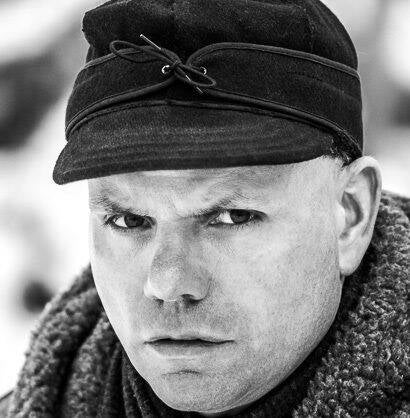
M: Sure! Though I’d probably look like Mawro with a bad case of the mange–I’m bald beneath that wool cap you see me wearing in my author photo!
Major thanks to Mark for having this conversation with me! The entire Forest Exiles saga is out now – see below for details!

Werecats Emergent is the first installment in the Forest Exiles Saga, where themes of transformation, legacy, retribution, and atonement take the shape of a serious page-turner. But don't let those themes fool you! It's fun, fast, and a great entry-point to the urban and anthromorphic fantasy subgenres.
Afflicted, exploited, and deadly…
Teenaged Pawly discovers her secret werecat heritage after unexpectedly morphing into a lynx one Halloween night. She and her twin brother thrill as they explore their newly revealed abilities, never far from the watchful eye of their blended human-werecat family. But the old folks know that unless they can find an outlet for the twins’ growing bloodlust, they will both soon turn feral.
Meanwhile, Pawly’s uncle Ritzi scrambles to develop a means to sate her and her brother’s lethal urges. Resuming his deported father’s scientific research and desperate for funding, Ritzi draws notice from a nefarious rogue state eager to help—and to exploit the twins’ lethal potential.
As her family strives to keep the twins’ blood rage in check, Pawly finds herself caught between a Chicago-area drug cartel and the rogue state wooing her uncle. While either could aid in reining in her inner beast, neither has her family’s best interest at heart. Unless a solution can be found quickly, Pawly and her brother will both succumb to their feral natures. And this time, more than just the family pet will end up torn to shreds.
Werecats Emergent and additional Forest Exiles Saga books feature the modern-day remnant of an ancient clan of werecats, torn apart as militaries on three continents vie to exploit their deadly talents. Stories which fans of Patricia Briggs’ Mercy Thompson franchise and Brad Magnarella’s Blue Wolf series can sink their teeth into!
Tamara receives no compensation, financial or otherwise, for these interviews. Neither is she responsible for the content contained in external links.
However, if you enjoy them, you can always buy her a coffee!
Add comment
Comments