If there's one thing I've grown to love about my journey into the world of self-publishing, it's getting to talk with those who've come before me. As such, I decided to start conducting more structured interviews as a way to both enrich and give back to our community and – what's more – introduce readers who love my work to their next favorite authors! I can't think of a better place to start than with fellow cerebral epic fantasy author C.E. Wright.
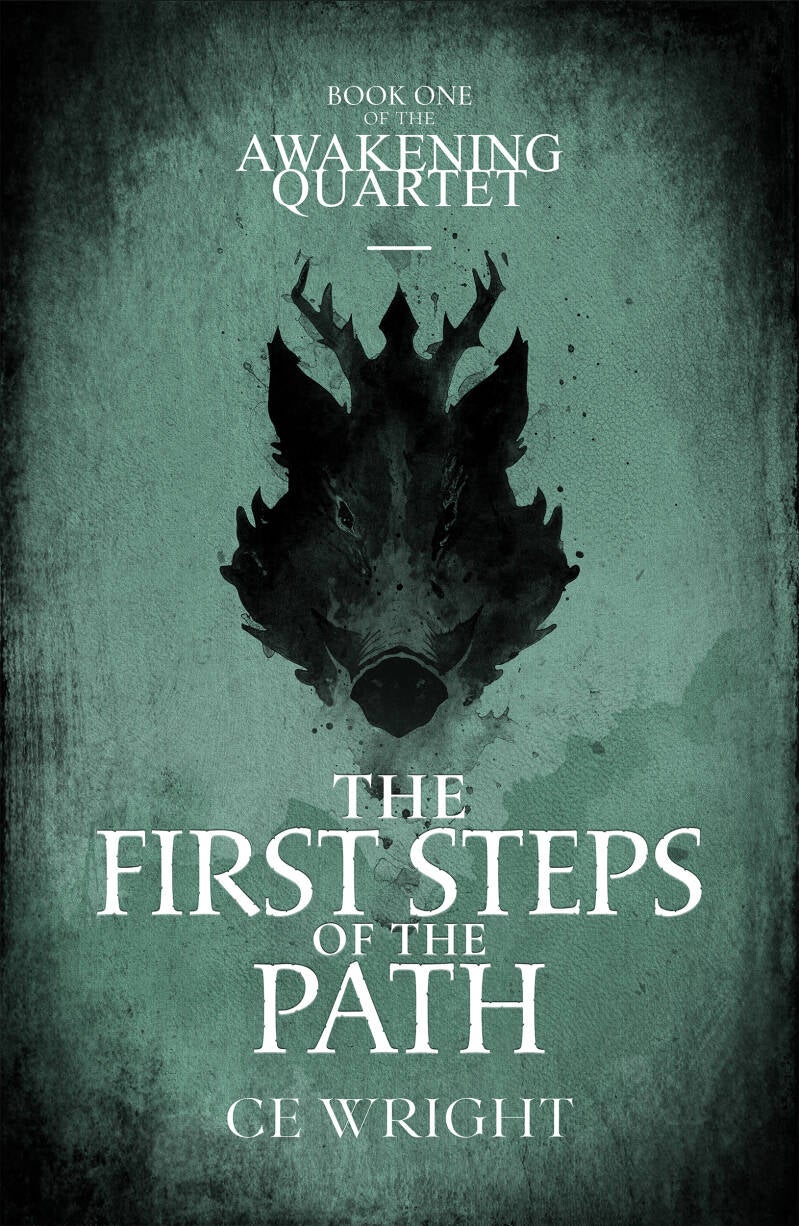
In this inaugural entry we discuss his debut novel, The First Steps of the Path, plus AI, the role of storytelling in today's society...and the perfect cup of tea.

This interview is spoiler-free!
Tamara: Let's start in the shallows. What inspired you to undertake The First Steps of the Path?
Colin: A cocktail of hubris, boredom, and nerd-sniping myself. During COVID, I read a book – which I can’t even remember now – that I didn’t think was very good and had the dangerous thought that ‘I can do better than this’, at a point when I just happened to have a lot of free time in the evenings. I’ve always loved reading since I was very young, so the idea of writing had always been sitting around in the back of my head somewhere, and once I got started, I found it hard to abandon the ideas, world, and characters.
T: Writers typically get classified into 'gardeners' or 'architects', but recently this seems to have split further into 'planner, planter, or pantser'. Which of these, if any, would you say describes you?
C: You know, I’m not 100% sure. To some degree, I think this is a false dichotomy (or trichotomy), and in practice, one does a bit of everything. Some elements of the story and the theme have been set from the get-go. Often, I plan out narrative arcs, but at other times, I let things evolve a bit more dynamically during a writing session. Maybe that locates me further towards the architect end of the spectrum?
T: Speaking of writing sessions, describe your ideal one!
C: I find a café or a quiet pub to be best – away from the distractions of home, but somewhere with a bit of background hubbub.
T: And which part of the writing process do you enjoy the most? Which do you dread?
C: It’s a close-run thing, but I probably enjoy coming up with new ideas and large-scale plotting the most. There isn’t anything I dread. One of my personal ‘hacks’ I use when working is to let my state of mind guide which work I pick up during a given writing session. If I find I’m more in the ‘mood’ for editing, I will switch to that over, say, writing a new chapter, and vice versa.
T: Do you find you write linearly, or do you jump around?
C: I would say 80-90% linearly, with occasional jumps, perhaps to get unstuck, clarify a future scene, or just follow a sudden inspiration.
T: Shifting subjects slightly: you and I met due to your ARC campaign, and have been commiserating over the trials, tribulations, and joys of self-publishing. What led you to choose the indie route?
C: A big part of it is creativity and control. If I want to write a quartet of dense, complex books, I can. I retain final say over everything from the content and book length to the cover and marketing approach. That allows me to stick to my vision and produce something I’m proud of. Of course, that might mean I end up publishing works with smaller market appeal, but that’s a trade-off I’m okay with (and, to some extent, I am sceptical that anyone, including traditional publishers, can predict this stuff with much accuracy).
Also, perhaps unlike some authors, I quite enjoy the business side of things, and it’s been interesting to learn about everything from internal formatting to how advertising works. The indie space also feels more experimental and forward-looking. E.g., I can try new things and publish on my own schedule; the (potential) multi-year timelines of the traditional route seem a bit outdated in this day and age.
T: Something that's been inescapable for both indies and traditionally-published authors has been the surge in AI services, features, and competition. How do you feel about AI?
C: I feel like this is a very charged topic at the moment, with strong opinions on both sides. It’s clearly a powerful technology, and like any powerful technology, the degree to which it does good or ill will come down to how we, as humans, decide to build and use it.
In the broader societal sense, there are many open questions. Does the technology live up to the hype, and/or are we in a market bubble? Does the current LLM approach provide a viable pathway to AGI, or will we hit a capability ceiling? How severe are job losses going to be, and how will we reconfigure society if they are significant? I have (constantly evolving) thoughts on all of these, but I can’t claim to have any answers.
When it comes to writing, I don’t use AI, aside from some limited research purposes. In part, that’s because I don’t think it’s good enough. It can write quite well in short stints, but falls apart on longer stuff (in my experience). It also has a tendency to sound the same, which perhaps isn’t too surprising given that LLMs are, to some degree, just statistical inference engines. Many of the writers I admire, I do so for their unique voices. That’s something I don’t want us, as a society, to lose. We also haven’t resolved the question of how artists get paid (there are various copyright lawsuits ongoing, for example), and, as an artist who would like to get paid, I do not wish to be hypocritical at this juncture, so I steer clear and continue to pay others with whom I work (e.g., my cover designer).
To provide a small counterweight to that, as someone who has more ideas than I have time to write, there is some appeal in a system that would allow me to complete books more quickly. At the moment, it doesn’t look like the right trade-off, but perhaps that will change in future. I think labelling will become important in this space; we should be clear about where AI is involved, so consumers of our work can make an informed decision.
T: With AI now being commonly considered as the antithesis to creativity and storytelling, what role do you feel fiction, and fantasy in particular, has today?
C: I don’t think there is a straightforward answer to this, but I would note that storytelling has always played an important role in human society, and I believe it will continue to do so, though the how and why will differ from person to person and from one time to another.
I believe there’s an element of escapism, of being able to get outside of the confines of our own lives and experience something new and different. But I also think that good fiction often reflects the world. What’s that Albert Camus quote? "Fiction is the lie through which we tell the truth." I cover elements of philosophy, psychology, morality, and historical parallels (to name a few subjects) in my books, and if that encourages people to think about such things in the real world, I consider that a good thing.
T: This is the perfect segue for me, because I wanted to mention that I loved the prominent tackling of philosophical themes in FSotP, from utilitarianism to free will versus determinism. Did you set out to explore these or did they evolve naturally? Did you have a ‘philosophically educated’ reader in mind?
C: This lay near the heart of my thinking from the beginning. Without getting into spoilers, I would say these elements play a continuing and expanding role in the sequels and are a core part of the whole experience and central thematic throughline.
I wouldn’t say I’m targeting a philosophically educated reader per se. Indeed, I expect any true experts could poke plenty of holes in my somewhat amateur meandering. That said, it’s probably true that I’m aiming at the patient reader who wants to reflect on their fantasy readings and engage with topics beyond the action and interpersonal drama.
T: I was also struck by Isenya's portrayal and a little surprised (happily) that she became the backbone of the narrative. Was this intentional or more subconscious? Has a character ever surprised you during the writing process?
C: This was intentional. Isenya was the first protagonist to coalesce from the mélange of early ideas I had, with certain elements of her character specifically chosen to support the book's overarching themes. For example, I wanted someone who used their intellect to move through the world, rather than relying on martial strength or magic. Amongst other things, this provides us with a window into the narrative's more philosophical elements.
Yeah, I think characters have surprised me, and there’s a sense in which we have grown together. This is usually in the manner that something suddenly fits together, rather than anything completely left field. I.e., a twist I hadn’t initially planned, but once I’d thought of it, felt like it really suited and solidified their arc.
T: Another thing I loved was the grand scale of your setting and the pervasive sense of history it gave. Where would you most like to live in your world?
C: As someone who loves learning, it would have to be either one of the schools in Valänge, or (if I were so gifted), studying at the Halls of Mindar in Vannegar.
T: On the subject of learning, what's the oddest thing you researched for the book?
C: I’m a bit of a geek for maps. For my world map, I wanted to create something that could handle everything from distances to climate and crop types. As a result, I ended up learning quite a bit about GIS (the Geographic Information System) and about how systems like Google Maps work.
T: Do you have any plans for a lore book?
C: Nothing concrete at the moment, although I do love writing the lore of the world. The map on my website includes a mix of lore from my books, jumbled with some original material, and I plan to expand it over time. Perhaps at some point I’ll collate all that into a book.
T: FSotP is itself a bit of a doorstop! Was this intentional? Do you find you gravitate toward chunky books yourself?
C: It wasn’t intentional in the sense that I had a page count in mind when I began; however, I was always aiming to write a deeply realised world, full of complexity, that I could immerse readers in, so I think that naturally pushed me towards something longer. And yes! I am one of those people who love a hefty tome, so doubtless that played a part as well.
T: A perhaps divisive question, now: Hardback, paperback, eBook, or audiobook?
C: My favourite format is paperback. I love the feel and smell of a book in my hands. However, in practice, I probably read more eBooks. The portability is hard to beat.
T: To round up, I first have a question with aspiring fantasy writers in mind: Do you have any advice for them? In general, what advice do you not agree with?
C: Oh golly, I don’t know if I feel established enough to be handing out advice. One thing I would say to those starting out on their journey is that consistency is likely the most powerful lever for your progress. There’s the old Stoic idea that a person is what they do every day, and I think there is some truth in that. If you want to be a writer, write. Completing a novel is a long process, but you’d be surprised how much you can get done a little bit at a time. And nothing improves your writing as much as simply doing more of it.
T: My second round-up question has readers in mind: What feeling or impression do you most hope they're left with when they turn the final page of The First Steps of the Path?
C: This is a difficult one! Perhaps most of all, they are left with a sense of having been to a different world, one they would like to return to in order to understand the fates of characters, and to explore the mysteries and places yet to be revealed.
T: Finally, the most crucial question of them all: What’s your usual coffee order? Describe the perfect cup of tea.
C: Coffee-wise, I’m partial to a flat white. The perfect cup of tea would come on a rainy day after a long hike: Yorkshire Tea, not too much milk, no sugar, shared with a friend as we put the world to rights.
Major thanks to Colin for taking the time to talk with me and embark on this little experiment! The First Steps of the Path is out now – see below for details!
The First Steps of the Path is the first installment in the Awakening Quartet, a grand introduction to a myriad of empires and philosophies and the varied characters that struggle within them. I, Tamara, consider it the thinking man's epic fantasy, Homeric in scale and utterly engrossing.
The Kingdom of Aver stands upon a knife’s edge.
In the north, Isenya Kalthane, daughter of a ruling steward, fans the flames of rebellion. Working under the aegis of a secretive group of philosophers, she schemes to take her father’s place and forge an unlikely alliance with the kingdom’s enemies, all to stand against a rising threat that few can see. Yet, walking this path will demand a cost. How much is she willing to sacrifice?
Away to the south, the spy, Grey, moves through the kingdom like a shadow, dispatched by his emperor to sow discord and fracture alliances. With two deadly assassins under his command, he is a blade in the dark, poised to disrupt best-laid plans. Yet even he is a pawn in a larger game whose true players remain unseen.
While conflict looms, young Apsalior is thrust into an adventure he neither sought nor imagined. Bound for distant shores aboard the Passing Storm, he must navigate treacherous waters—both real and political—where pirates, bandits, and the arcane mysteries of the sōng await.
As forces converge and blood is spilt, the destiny of the land will be rewritten.
Tamara receives no compensation, financial or otherwise, for these interviews. Neither is she responsible for the content contained in external links.
However, if you enjoy these interviews, you can always buy her a coffee!
Add comment
Comments